01246 277 271
Each breast patient will be offered an 'End of Treatment' appointment when they have completed their adjuvant treatment, such as chemotherapy or radiotherapy.
This appointment is a 30 minute telephone consultation with one of the Breast Clinical Nurse Specialists, who will discuss with you and summarise the treatment you’ve had.
Following this appointment, they will send you a copy of your ‘Treatment Summary’, along with any further support information, health and wellbeing leaflets and guidance on how to access the service should you experience any breast related problems in the future. Your GP will also receive a copy of the treatment summary.
If you find the appointment date is inconvenient then please call us on 01246 512356 to re-arrange your appointment. Alternatively, you can email us on: CRHFT.
There are currently two follow-up pathways for Breast Cancer patients, Supported Self-Management and Long-Term Clinical Follow-up. Read more about each one below.
If you were diagnosed with Ductal Carcinoma in-situ (DCIS) - after your End of Treatment appointment you will be discharged to the care of your GP, but you'll still be invited every year for mammograms, at Chesterfield Royal Hospital for five years following surgery.
The Breast Team will discuss each patient at a Multiple-Disciplinary Team meeting and decide which pathway would work best for every individual.
What is supported self-management follow up?
Supported self-management is follow up care for patients who have completed treatment for breast cancer. It replaces regular clinical appointments, which means that you don’t need to come to hospital when you are well, but you can still access the service when you need us.
How will it work for me?
When you have finished your treatment for breast cancer you will have End of Treatment appointment with your Clinical Nurse Specialist (CNS). During this appointment your CNS will discuss:
- Your diagnosis
- Medication
- The treatment you have had and the possible side effects
- Signs and symptoms to report
- Being body and breast aware
- Arrangements for annual Mammograms, if needed
- Bone density scans, if needed
- Psychological support
- How to use the Helpline which gives you access to the breast care team, if you need it.
Will I continue to have routine mammograms?
Unless you have been told otherwise, you will have mammograms every year, for five years.
Are there any other regular tests that I may need to have?
You and your GP will be told if you need any additional regular checks, such as bone density scans (DEXA scans).
Patients on this pathway are offered clinical appointments - usually three years from diagnosis, and again at year 5. You will see one of our clinicians where you will be examined and have the opportunity to discuss any issues or worries you might have post-treatment.
If you have any of the following signs or symptoms, at any point within 5 years of your diagnosis, you can re-access the breast services by contacting the breast care nursing team directly on 01246 512356:
- Lump / Thickening in the breast
- Lump / Thickening in the axilla (armpit)
- Blood stained nipple discharge
- Change in the shape or contour of the Breast
- Symptoms related to medication
- Changes related to mastectomy scar
The nurses can assess your issue over the phone and advise you accordingly, you might be booked in to a clinic for full assessment.
Patients who are more than 5 years on from their diagnosis or those presenting with a new problem in the opposite breast will need to be formally referred by their GP, under the 2 week-wait system.
Cancer Psychology Support Service - Read more about this service provided by our Clinical Psychologists, who specialise in supporting people who have cancer as well as those who have completed treatment.
NGS Macmillan Cancer Information and Support Centre - is based in the NGS Macmillan Unit at Chesterfield Royal Hospital. Anyone affected by cancer can drop into the centre to meet the staff and volunteers who will help you find the information and support you need.
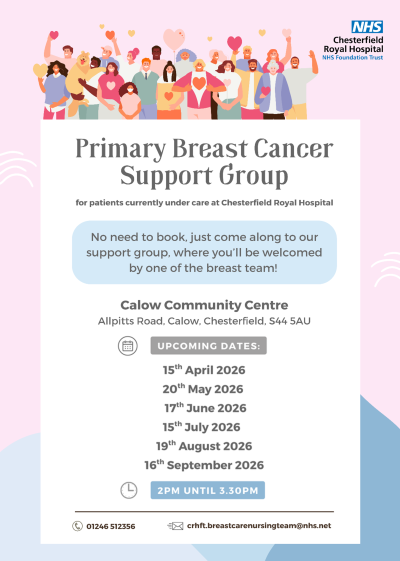
Chesterfield Royal Hospital's Support Group for Primary Breast Cancer Patients -